Practical guide for picking a model and provider when driving OpenCode through OpenRouter, balancing data-privacy risk against price and performance. Prices are as of 2026-09-27 and are OpenRouter’s listed rates.
Disclosure: I’m not affiliated with any of the model developers or service providers mentioned here.
1. Provider list vs model routing
OpenCode’s /connect connects providers; OpenRouter is one of them. Entries like “DeepSeek” and “DeepSeek (China)” are distinct serving endpoints — the suffix denotes the host’s jurisdiction, not a different model. To use OpenRouter as the payment gateway, connect OpenRouter once, then choose models with /models (for example deepseek/deepseek-v4-flash); the upstream host is then selected by OpenRouter’s routing, which you can constrain (see §5).
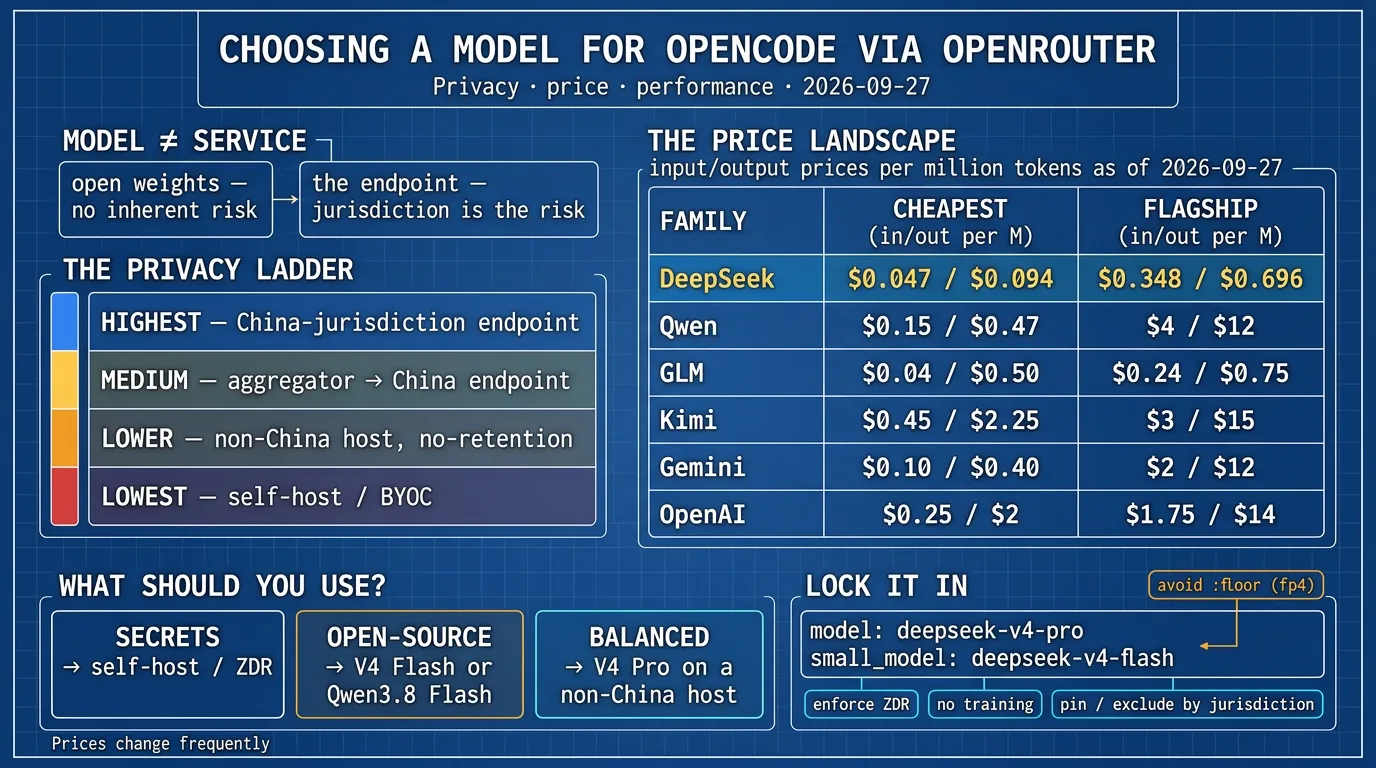
The distinction that matters throughout this note is between the model and the serving provider. An open-weight model (DeepSeek, Qwen, Kimi, GLM) is a set of downloadable files; it carries no inherent data risk. The risk lives in the service that hosts it and the law that governs that service.
2. Data privacy: model origin vs serving jurisdiction
A Chinese model is not the same as a Chinese service. The open weights can run anywhere — a non-Chinese host, your own GPU, or a laptop. What changes the privacy calculus is who operates the endpoint.
| Tier | Setup | Exposure |
|---|---|---|
| Highest | China-jurisdiction API endpoint (DeepSeek direct, Alibaba, Moonshot, .cn) receiving your code or secrets | Chinese law (National Intelligence Law, Data Security Law, PIPL) can compel disclosure and may bar disclosing the request |
| Medium | Non-China aggregator routing to a China endpoint without retention or training controls | Same legal exposure, but constrainable |
| Lower | Non-China host (Together, Fireworks, DeepInfra, Baseten, GMI) running the same open weights under no-retention terms | Contractual risk, not state compulsion |
| Lowest | Self-host (Ollama, llama.cpp, vLLM) or BYOC | No third-party exposure |
This is a jurisdiction and compulsion risk, not a claim that any vendor abuses data. It matters most for proprietary code and secrets; for public or open-source work the risk is low.
Assessment checklist per provider: (a) legal jurisdiction of the serving entity; (b) retention policy and whether Zero Data Retention is available; (c) training-on-inputs policy; (d) whether you can pin or exclude providers; (e) DPA availability; (f) whether self-host or BYOC is possible. In an agentic coding session, what you send is high-sensitivity — source, file contents, and sometimes secrets.
3. Pricing comparison
OpenRouter’s listed price is the cheapest endpoint for a model, and endpoints differ in quantization (fp4 vs fp8 weight precision — fewer bits is cheaper but lossy), so treat these as a floor, not a like-for-like quality figure.
Table generated 2026-09-27 from the OpenRouter API. Model prices change frequently — treat this as a snapshot and re-run the scripts in §4 before relying on any number.
| Family | Cheapest capable (input / output per M) | Frontier flagship (input / output per M) |
|---|---|---|
| DeepSeek | V4 Flash $0.047 / $0.094 | V4 Pro $0.348 / $0.696 |
| Qwen | Qwen3.8 Flash $0.15 / $0.47 | Qwen3.8 Max Prime $4 / $12 |
| GLM | GLM-5.3 Flash $0.04 / $0.50 | GLM-5.3 $0.24 / $0.75 |
| Kimi | K2.5 $0.45 / $2.25 | K3 $3 / $15 |
| Gemini | 2.5 Flash-Lite $0.10 / $0.40 | 3.1 Pro Preview $2 / $12 |
| OpenAI | gpt-5.1-codex-mini $0.25 / $2 | GPT-5.2 $1.75 / $14 |
Price winners: DeepSeek, with Qwen and GLM close. The open-weight families are far cheaper, especially on output tokens. DeepSeek V4 Pro is frontier-capable at roughly a twentieth of Gemini 3.1 Pro Preview’s and GPT-5.2’s output cost. Kimi is not a price leader — K3 sits at GPT and Claude frontier pricing. OpenAI is the priciest frontier; Gemini sits mid.
4. Reproducing the numbers
List every model’s price, per million tokens, with curl and jq:
curl -s https://openrouter.ai/api/v1/models \
  | jq -r '.data[] | [.id, (.pricing.prompt|tonumber*1e6), (.pricing.completion|tonumber*1e6)] | @tsv' \
  | sort -t$'\t' -k3 -n | head -30
Print the cheapest models per family with Python:
#!/usr/bin/env python3
"""Cheapest OpenRouter models per family, per million tokens."""
import json
import urllib.request

FAMILIES = {
    "deepseek": "deepseek",
    "qwen": "qwen",
    "moonshotai": "kimi",
    "google": "gemini",
    "openai": "openai",
    "z-ai": "glm",
}


def per_million(x):
    try:
        return float(x) * 1_000_000
    except (TypeError, ValueError):
        return None


with urllib.request.urlopen("https://openrouter.ai/api/v1/models") as resp:
    models = json.load(resp)["data"]

for author, label in FAMILIES.items():
    rows = [m for m in models if m["id"].startswith(author + "/")]
    rows.sort(key=lambda m: per_million(m["pricing"].get("completion")) or 9e9)
    print(f"=== {label} ({author}) — {len(rows)} models ===")
    for m in rows[:5]:
        p = m["pricing"]
        inp = per_million(p.get("prompt"))
        out = per_million(p.get("completion"))
        print(f"  {m['id']:<52} in ${inp:.3f}/M  out ${out:.3f}/M")
Inspect one model’s per-provider endpoints — price, quantization, context — the check that reveals the price floor:
curl -s "https://openrouter.ai/api/v1/models/deepseek/deepseek-v4-flash-0731/endpoints" \
  | jq -r '.data.endpoints[] | [.provider_name, .quantization, (.pricing.prompt|tonumber*1e6), (.pricing.completion|tonumber*1e6)] | @tsv'
5. Balanced recommendation
| If your data is… | Use |
|---|---|
| Proprietary or contains secrets | Self-host open weights, or a non-China host with Zero Data Retention via OpenRouter, or a Western frontier model. Avoid China-jurisdiction endpoints. |
| Open-source / non-sensitive | DeepSeek V4 Flash or Qwen3.8 Flash via OpenRouter — best price/performance for coding. |
| A balanced default | DeepSeek V4 Pro on a non-China host (cheap and non-China jurisdiction), with a cheap small model for routine steps. |
6. OpenCode configuration
{
  "$schema": "https://opencode.ai/config.json",
  "model": "openrouter/deepseek/deepseek-v4-pro",
  "small_model": "openrouter/deepseek/deepseek-v4-flash"
}
Controls to set on OpenRouter: enforce Zero Data Retention, opt out of training, and pin or exclude providers by jurisdiction. For agentic tool-calling reliability prefer the :exacto routing variant; avoid :floor, which often routes to fp4 and can degrade tool calls.
Sources
- openrouter.ai —
/api/v1/models,/api/v1/models/{author}/{slug}/endpoints,/docs/faq,/docs/guides/features/zdr - opencode.ai —
/docs/providers,/docs/models - Prices and model lists retrieved 2026-09-27.
btw, i use arch